

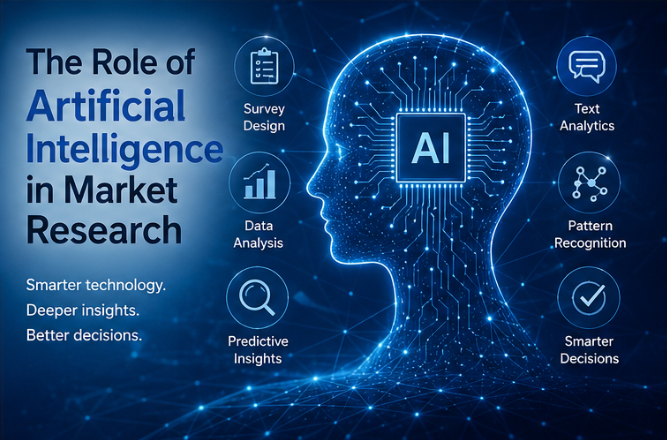
Artificial Intelligence is changing how businesses collect, analyse and use information[cite: 1].
Market research is no exception[cite: 1].
From survey design and data processing to text analysis and insight generation, AI can help researchers work with large volumes of information more efficiently[cite: 1].
However, AI should not be viewed as a replacement for sound research methodology[cite: 1].
The real opportunity lies in combining technology with human research expertise[cite: 1].
How Is AI Being Used in Market Research?
AI can support multiple stages of the research lifecycle[cite: 1]. These include:
-
Questionnaire development[cite: 1]
-
Data processing[cite: 1]
-
Open-ended response analysis[cite: 1]
-
Text classification[cite: 1]
-
Sentiment analysis[cite: 1]
-
Pattern identification[cite: 1]
-
Research summarization[cite: 1]
-
Data visualization[cite: 1]
-
Consumer segmentation[cite: 1]
-
Insight generation[cite: 1]
The exact application depends on the research objective and the type of data involved[cite: 1].
AI and Survey Research
Creating a good questionnaire requires understanding the research objective, target audience and information requirements[cite: 1].
AI tools can assist researchers by helping generate question ideas, identify potential gaps and organize questionnaires[cite: 1].
However, human review remains important[cite: 1].
A question that is technically correct may still be inappropriate because of cultural context, ambiguity, bias or respondent sensitivity[cite: 1].
AI can assist the process, but research expertise is still required to determine whether a question is actually suitable[cite: 1].
AI and Open-Ended Responses
One of the most useful applications of AI is the analysis of unstructured text[cite: 1].
Traditional analysis of thousands of open-ended responses can require significant manual effort[cite: 1]. AI-assisted techniques can help researchers identify:
-
Common themes[cite: 1]
-
Recurring complaints[cite: 1]
-
Product perceptions[cite: 1]
-
Sentiment[cite: 1]
-
Customer needs[cite: 1]
-
Emerging topics[cite: 1]
-
Frequently mentioned issues[cite: 1]
For example, imagine a customer survey generates 20,000 written responses[cite: 1]. AI can help organize those responses into meaningful themes so researchers can investigate the most important areas more efficiently[cite: 1].
AI Can Help Researchers Work Faster
Research projects often involve large volumes of information[cite: 1]. AI can assist with key workflows:
Large dataset → Classification → Pattern identification → Human review → Insight[cite: 1]
This can reduce the time spent on repetitive analytical tasks[cite: 1]. The goal is not simply to automate research[cite: 1]. The goal is to allow researchers to spend more time interpreting findings and connecting them to business decisions[cite: 1].
AI Does Not Eliminate the Need for Human Intelligence
One of the biggest misconceptions about AI in market research is that technology can independently produce perfect insights[cite: 1]. It cannot[cite: 1].
AI systems can identify patterns, summarize information and generate interpretations, but researchers still need to evaluate[cite: 1]:
-
Whether the data is reliable[cite: 1]
-
Whether the sample is appropriate[cite: 1]
-
Whether the research design is sound[cite: 1]
-
Whether the finding is statistically meaningful[cite: 1]
-
Whether the interpretation makes business sense[cite: 1]
-
Whether the conclusion is supported by the evidence[cite: 1]
This is particularly important when research findings influence major commercial decisions[cite: 1].
The Importance of Data Quality in AI
AI is only as reliable as the information being processed[cite: 1]. Poor-quality research data can produce misleading AI-generated conclusions[cite: 1].
Industry discussions on synthetic data and AI in research have highlighted the importance of original, high-quality data and the risks associated with poor-quality inputs[cite: 1].
Better data → Better analysis → Better insights[cite: 1] Quality inputs determine the validity of AI conclusions
AI and Synthetic Respondents
Another emerging area is the use of synthetic participants or AI-generated respondents[cite: 1]. These technologies may provide researchers with new ways to explore hypotheses, simulate scenarios or supplement traditional research[cite: 1].
However, synthetic approaches should be evaluated carefully and not automatically treated as equivalent to real human respondents[cite: 1]. Researchers need to understand:
-
How the synthetic data was generated[cite: 1]
-
What assumptions were used[cite: 1]
-
What biases may exist[cite: 1]
-
How closely it represents the target population[cite: 1]
-
Where real-world validation is still required[cite: 1]
Privacy and Responsible AI
AI-enabled research also creates important questions around privacy and data protection[cite: 1]. Researchers need to understand what information is being collected, where it is processed, how it is stored and who can access it[cite: 1].
Industry guidance emphasizes the importance of privacy notices, data protection practices and safeguards when AI-based services are used for market research[cite: 1]. Responsible research therefore requires more than adopting the latest technology—it requires appropriate governance[cite: 1].
The Future of AI in Market Research
AI is likely to become increasingly integrated into research workflows[cite: 1]. We can expect continued development in areas such as:
-
Automated data analysis[cite: 1]
-
Conversational surveys[cite: 1]
-
AI-assisted qualitative analysis[cite: 1]
-
Multilingual research[cite: 1]
-
Automated coding[cite: 1]
-
Advanced segmentation[cite: 1]
-
Predictive analytics[cite: 1]
-
Real-time insight generation[cite: 1]
The strongest research organizations will not simply be those using the most AI[cite: 1]. They will be the organizations that know where AI adds value and where human judgment remains essential[cite: 1].
AI + Human Intelligence
The future of market research is not necessarily AI instead of researchers[cite: 1].
A more practical model is: AI + Research Expertise + Human Judgment[cite: 1]
AI can process information quickly[cite: 1]. Researchers can understand context[cite: 1]. Business leaders can make decisions[cite: 1]. Together, these capabilities create a stronger research process[cite: 1].
How InsightsIQ Approaches the Future of Research
At InsightsIQ, we believe technology should strengthen research rather than replace research fundamentals[cite: 1].
Our focus remains on understanding the research objective, reaching the appropriate audience, collecting quality information and transforming data into actionable insights[cite: 1].
As technologies such as AI continue to evolve, we see significant opportunities to improve research efficiency while maintaining the principles of quality, transparency and responsible data use[cite: 1].
Final Thoughts
Artificial Intelligence is creating new possibilities across the market research industry[cite: 1]. But technology alone does not create reliable insights[cite: 1].
The right question.
The right audience.
The right methodology.
The right data.
The right analysis.[cite: 1]
The right audience.
The right methodology.
The right data.
The right analysis.[cite: 1]
AI can make many parts of that process faster and more scalable[cite: 1]. Human expertise ensures that the results remain meaningful[cite: 1]. The future of market research will belong to organizations that can combine both[cite: 1].